

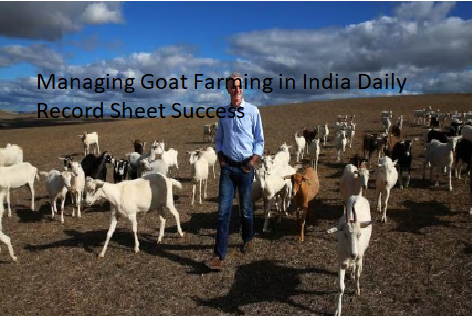
Maintaining a goat farming in India daily record sheet is the single most effective way to transition from a hobbyist to a profitable commercial enterprise. Without precise data, you are essentially guessing your margins, which is a recipe for financial instability in the livestock sector.
By tracking every input and output, you gain the clarity needed to make evidence-based decisions regarding feed, health, and breeding. This practice ensures that you are not just keeping animals, but managing a business that respects the realities of the Indian agricultural market.
The Core Function of Daily Documentation
The primary purpose of a goat farming in India daily record sheet is to provide a granular view of your operational efficiency. You must record the daily feed intake for each pen, as this allows you to calculate the feed conversion ratio accurately.
If a specific group of goats is consuming more fodder than they are gaining in weight, your record sheet will highlight this inefficiency immediately. This allows you to adjust your feed mix before the issue impacts your bottom line.
Beyond feed, daily logs serve as a medical history for every animal in your herd. In the Indian climate, where heat stress and seasonal parasites are constant threats, having a written record of vaccinations and deworming cycles is mandatory.
A daily sheet helps you identify which animals are underperforming or showing early signs of illness. You can track body temperatures and behavioral changes, which are often the first indicators of a looming health crisis.
Essential Metrics for Your Record Sheet
To build a functional goat farming in India daily record sheet, you need to include specific columns that capture the heartbeat of your farm. Start with the basics: individual animal identification numbers, their date of birth, and breed.
You should also include a section for daily feed consumption measured in kilograms, broken down by concentrate and green fodder. This data is vital for forecasting your monthly expenses and managing your inventory of feed supplies.
Health logs should be equally detailed, featuring columns for medication administration, dosage, and the specific veterinarian who authorized the treatment. Mortality rates must be recorded with extreme precision, including the suspected cause of death.
If you are running a dairy-focused operation, your daily sheet must account for milk yields per doe. Tracking these numbers over time will reveal which lines of your herd are the most productive and which should be culled.
Financial Tracking and Profitability
A robust goat farming in India daily record sheet acts as your primary financial ledger. You should track daily labor hours, electricity costs for shed maintenance, and transportation expenses for moving fodder or livestock.
By aggregating these daily inputs, you can calculate the exact cost of production per kilogram of meat or liter of milk. Many farmers fail because they mix their personal household expenses with their farm’s operational costs; your record sheet keeps these separate.
You should also maintain a clear record of all sales, noting the weight of the animal at the time of sale and the final price per kilogram. This allows you to monitor market trends in your local mandi or direct-to-consumer channels.
When you compare your total input costs against your sales revenue, you obtain your net profit margin. If your margins are shrinking, your records will show you exactly which cost category is inflating, whether it is high veterinary costs or excessive feed wastage.
Standardized Data Collection Template
Implementing a consistent structure is vital for long-term record-keeping success. While you can use a digital spreadsheet, many small-scale farmers in rural areas prefer a physical ledger for ease of access in the shed.
Regardless of the format, your daily entries should follow a predictable pattern. Below is a simplified structure that you can adapt for your daily operations.
- Animal ID: A unique tag number for every individual in the herd.
- Feed Intake (kg): Daily weight of concentrates and roughage consumed.
- Health Notes: Observations on energy levels, appetite, and physical condition.
- Medical Actions: Vaccines, deworming agents, or antibiotics administered.
- Production Data: Daily milk output in liters or weight gain in kilograms.
- Expenses: Daily cash outflows for supplies, labor, or emergency services.
Data Analysis and Herd Management
Once you have gathered a few months of data, your goat farming in India daily record sheet becomes a diagnostic tool. You can use this information to identify seasonal patterns in your herd’s health.
For example, if your records show a spike in respiratory issues during the monsoon season, you can proactively adjust your shed ventilation or bedding management next year. This is the difference between reactive management and strategic planning.
You should also use your records to refine your breeding program. By tracking the growth rates of kids born to specific sires and dams, you can identify which breeding pairs produce the most robust offspring.
This data-driven approach allows you to select for traits that are highly valued in the Indian market, such as rapid weight gain or high milk fat content. Over several years, this practice significantly increases the genetic value of your herd.
Comparison of Operational Costs
Understanding how your costs compare across different stages of production is crucial for scaling your farm. The following table illustrates a typical breakdown of operational expenses that should be tracked in your daily records.
| Expense Category | Frequency | Estimated Impact |
|---|---|---|
| Green Fodder | Daily | High (30-40% of total) |
| Concentrate Feed | Daily | High (25-35% of total) |
| Veterinary Care | Occasional | Medium (10-15% of total) |
| Labor Wages | Monthly | Medium (10-20% of total) |
| Electricity/Shed | Monthly | Low (5% of total) |
Leveraging Technology for Record Keeping
While paper ledgers are reliable, transitioning to digital tools can enhance your ability to analyze your goat farming in India daily record sheet. Excel or Google Sheets allow for automated calculations, such as summing up monthly feed costs or generating growth charts for specific kids.
These digital formats also make it easier to store years of data without the risk of losing physical notebooks to moisture or pests. You can even use mobile apps specifically designed for livestock management if you have reliable internet access.
For further information on best practices for livestock management, refer to the Department of Animal Husbandry and Dairying, which provides valuable resources for Indian farmers. Integrating their guidelines into your daily documentation ensures that your farm remains compliant with national standards.
Digital records also make it much easier to share information with bankers or investors if you are seeking a loan to expand your operations. They want to see consistent, verifiable data, and a well-maintained digital sheet is the best way to prove your farm’s viability.
Common Pitfalls in Record Keeping
The biggest mistake farmers make is failing to record data consistently. You might skip a few days during busy harvest periods, but those missing gaps in your goat farming in India daily record sheet create blind spots.
A single day of missing health data could mean you forget to administer a booster shot, leading to a preventable disease outbreak. Treat your record-keeping as a non-negotiable part of your daily chores, just like feeding or cleaning.
Another common error is failing to be specific enough in your observations. Writing “animal looks sick” is useless; writing “ID #402, lethargic, temperature 104°F, reduced appetite” is actionable information.
Your records are only as good as the detail you put into them. If you cannot look back at a note from six months ago and understand exactly what happened, you need to improve your reporting standards.
Frequently Asked Questions
How often should I update my goat farming in India daily record sheet?
You should update your records at least once every day, ideally in the morning during the first feed or in the evening during the final inspection. Consistency is more important than the time of day, but doing it daily prevents the buildup of backlogged data.
Can I use a single notebook for all my farm records?
While possible, it is better to have separate sections or logs for health, feed, and financial transactions. This makes it much easier to calculate specific metrics, like your total monthly expenditure on grain, without having to flip through hundreds of pages of medical notes.
How do I calculate profit if my goats are not sold daily?
Profit is calculated by subtracting your total accumulated daily costs from the final sale price of the animal. By tracking every daily input—feed, medicine, and labor—you will know your exact “cost of production” for each goat, which tells you your minimum acceptable sale price.
What is the most important data point to track?
While every entry is important, tracking feed intake and weight gain is critical for profitability. This ratio determines whether your business is actually making money or if you are spending more on feed than the animal’s value growth justifies.
Should I keep digital or physical records?
Physical records are excellent for immediate use in the field, but digital copies are superior for long-term analysis and safety. The best approach is to maintain a daily field notebook and transfer that data into a digital spreadsheet once a week for permanent storage and analysis.
Conclusion
Establishing a consistent goat farming in India daily record sheet is the foundation of a sustainable and profitable agricultural business. By capturing every detail—from the weight of fodder consumed to the specific dates of medical interventions—you transform your farm into a predictable, manageable asset. This level of oversight allows you to spot inefficiencies, optimize your feeding strategies, and ultimately increase your profit margins in a competitive market.
Do not let the task of documentation overwhelm your daily schedule. Start with a simple, manageable template and build your habit of recording data every single day.
As your farm grows, the historical data you have collected will become your most valuable tool for planning future expansions. Commit to this practice today, and you will find that your decision-making becomes sharper, your herd becomes healthier, and your business becomes significantly more resilient.
