

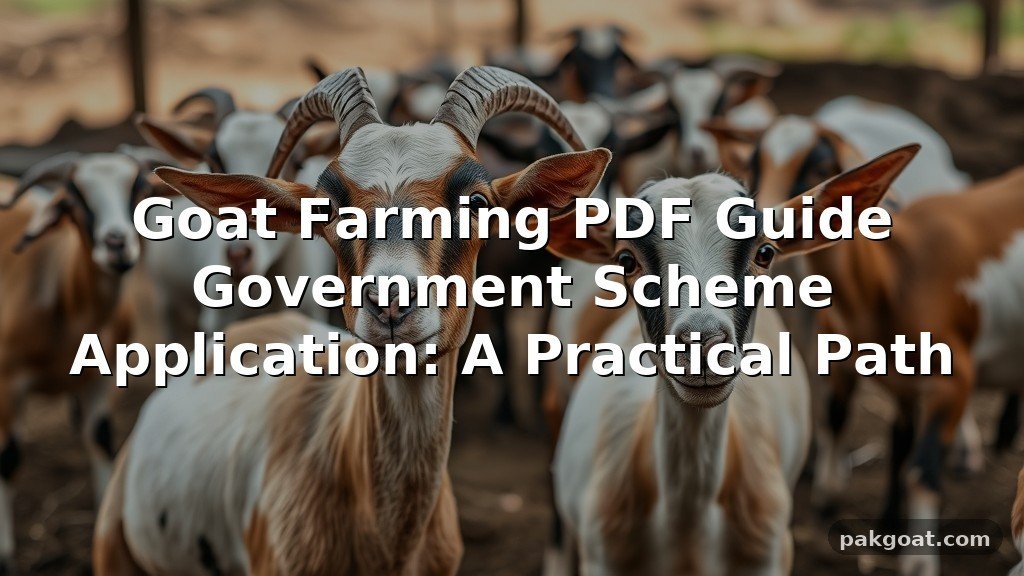
Understanding a goat farming PDF guide government scheme application is essential for anyone looking to secure financial support for their livestock venture. In many regions, the process begins with identifying the correct regional department, usually the Department of Animal Husbandry, which provides the necessary documentation and eligibility criteria. Most applicants can expect to receive between 30% and 50% of the project cost as a subsidy, depending on their category and the specific state policy.
This financial backing is designed to lower the barrier to entry for small-scale farmers. By gathering the right paperwork early, you ensure your project meets the technical requirements for approval.
Understanding Subsidy Eligibility and Scope
Financial assistance for livestock often comes with strict criteria regarding project size and location. You must ensure your farm plan aligns with the government’s specific objectives, such as promoting employment in rural areas or improving local meat and milk production.
Most schemes require the applicant to have a minimum of 10 to 20 female goats and one male goat to qualify for the base-level financial aid. Larger commercial units, often exceeding 100 goats, fall under different categories that may offer higher capital investment support but demand more rigorous auditing.
It is critical to verify if your specific region mandates a particular breed for the subsidy. For instance, some states prioritize the distribution of high-yielding breeds like the Osmanabadi or Sirohi to maximize the economic impact of the grant.
You should check the official Department of Animal Husbandry and Dairying portal for the most recent updates on breed-specific incentives. Always confirm whether your land ownership documents are sufficient, as some programs require proof of a dedicated shed area and grazing land.
Documenting Your Business Plan
A professional project report is the backbone of any successful goat farming PDF guide government scheme application. This document must detail your operational costs, including purchase prices for livestock, construction materials for shelters, and estimated veterinary expenses.
Officials look for realistic projections that show you have considered the long-term viability of the farm. If your numbers are too optimistic, or if you fail to account for seasonal fluctuations in feed prices, your application is likely to be rejected.
Break your costs down into clear categories to make the reviewer’s job easier. You should include a section on labor costs, water management, and biosecurity measures.
Providing a clear timeline for your infrastructure development, such as when the shed will be completed and when the first batch of goats will be acquired, demonstrates operational readiness. Many applicants find that working with a local agricultural consultant helps in formatting these reports to meet institutional standards.
Financial Breakdown of Typical Startup Costs
The following table provides an estimated comparison of initial capital requirements for a small-scale farm versus a mid-sized commercial operation. These figures are approximations based on typical market rates and should be adjusted for your local currency and current inflation.
| Cost Category | Small Farm (20 Goats) | Commercial Farm (100 Goats) |
|---|---|---|
| Shed Construction | $1,500 | $7,000 |
| Livestock Purchase | $3,000 | $15,000 |
| Equipment/Tools | $500 | $2,500 |
| Initial Feed/Medication | $800 | $4,000 |
| Total Investment | $5,800 | $28,500 |
Navigating the Application Filing Process
Once your documents are ready, the submission process usually involves an online portal or a physical visit to the District Veterinary Office. You will need to submit your identity proof, land records, a passport-sized photograph, and the detailed project report mentioned earlier.
Many states have moved to a digital-first approach to reduce corruption and improve transparency in the distribution of funds. It is helpful to request a receipt or an application reference number at the moment of submission.
Follow-up is just as important as the initial filing. If you haven’t heard back within the stipulated time frame, which is often 30 to 60 days, visit the office to inquire about the status of your file.
Sometimes, a minor clerical error can stall the entire process, and a proactive approach allows you to correct these issues quickly. Ensure you keep copies of every document you submit for your own records.
Infrastructure Requirements for Approval
Government inspectors prioritize farms that meet basic animal welfare standards. Your shed must provide adequate ventilation, protection from predators, and enough space for the herd to move comfortably.
Overcrowded conditions are a common reason for application rejection, as they lead to higher disease rates and lower productivity. Ensure your design includes a separate area for sick animals, which is a mandatory requirement for many institutional grants.
Water and feed storage are other areas that inspectors will scrutinize. A sustainable farm must show it has a reliable water source that won’t dry up during the summer months.
If you intend to use a zero-grazing system, you must demonstrate how you will source or grow enough fodder to support the herd throughout the year. Having a dedicated storage area for dry fodder and a clean water trough system is essential for approval.
Key Components of a Successful Herd Management Plan
Your management plan should outline how you intend to maintain the health and growth of your herd. This includes a vaccination schedule, a breeding strategy, and a plan for routine veterinary check-ups.
Mentioning that you have a local veterinarian on call significantly improves the credibility of your application. The goal is to show the government that you are investing in a sustainable, long-term business rather than a temporary project.
- Vaccination Schedule: Documenting the timing for PPR, FMD, and Enterotoxaemia vaccines.
- Breeding Strategy: Explaining your plan for genetic improvement to increase meat or milk yield.
- Feed Management: Detailing the mix of concentrates, green fodder, and dry roughage.
- Record Keeping: Describing your system for tracking births, deaths, and sales.
- Waste Management: Outlining your plan for manure disposal and potential composting.
Understanding Subsidy Disbursement Cycles
Subsidy payments are rarely distributed in a single lump sum. Typically, the government releases funds in stages, linked to the progress of your farm setup.
You might receive the first installment after the shed construction is verified, and the final payment after you have purchased the livestock and passed a post-installation inspection. This structure is intended to ensure that the funds are actually used for the project and not diverted elsewhere.
Be prepared for these inspections. Keep your accounts and receipts organized so that you can prove how every dollar was spent.
If your expenses deviate significantly from your original project report, you may face delays in receiving subsequent payments. Always communicate with your regional officer if you need to make changes to your project plan, as prior approval is often required to keep your subsidy eligibility intact.
Common Pitfalls and How to Avoid Them
Many applicants fail because they underestimate the importance of local networking. Attending regional workshops or talking to existing farmers who have successfully obtained government support can provide you with insights that aren’t in any official manual.
Avoid using agents or middlemen who promise to “fast-track” your application for a fee. These individuals often complicate the process and can even lead to your application being blacklisted for fraudulent activity.
Another common mistake is neglecting the marketing side of the business. The government wants to see that you have a plan for selling your product, whether that is meat, milk, or manure.
Research your local markets, identify potential buyers, and include this information in your business plan. A farm that has a clear path to profitability is far more attractive to a review committee than one that relies solely on subsidies to exist.
Long-term Sustainability and Scaling
Once your farm is operational, focus on scaling at a sustainable pace. Rapid expansion without proper infrastructure often leads to high mortality rates, which can jeopardize your reputation and future eligibility for government grants.
Use the profits from your first few cycles to improve your facilities and invest in better breeding stock. This organic growth is much more stable than relying on constant injections of capital from outside sources.
Keep detailed records of your performance metrics from day one. You should track your feed conversion ratio, the average weight gain per goat, and the mortality rate of your herd.
These numbers are invaluable when you want to apply for further expansion loans or higher-tier government schemes. By treating your farm like a data-driven business, you position yourself for long-term success in the livestock industry.
Final Thoughts on Government Support
Successfully navigating a goat farming PDF guide government scheme application requires patience, attention to detail, and a commitment to following official procedures. By focusing on a strong business plan, proper infrastructure, and transparent record-keeping, you significantly increase your chances of securing the support you need.
The government’s goal is to fund viable, productive, and sustainable farms that contribute to the local economy. When you present your project as a professional, well-managed enterprise, you align your interests with those of the funding body.
Start by gathering your documentation and visiting your local veterinary office to get the most recent guidelines for your area. Do not rush the application process; ensure every detail in your project report is accurate and reflective of your true intentions.
With the right preparation, you can successfully leverage these schemes to build a productive and profitable goat farming business. Reach out to your local agricultural extension office today to begin your journey toward a secure and supported farming future.
