

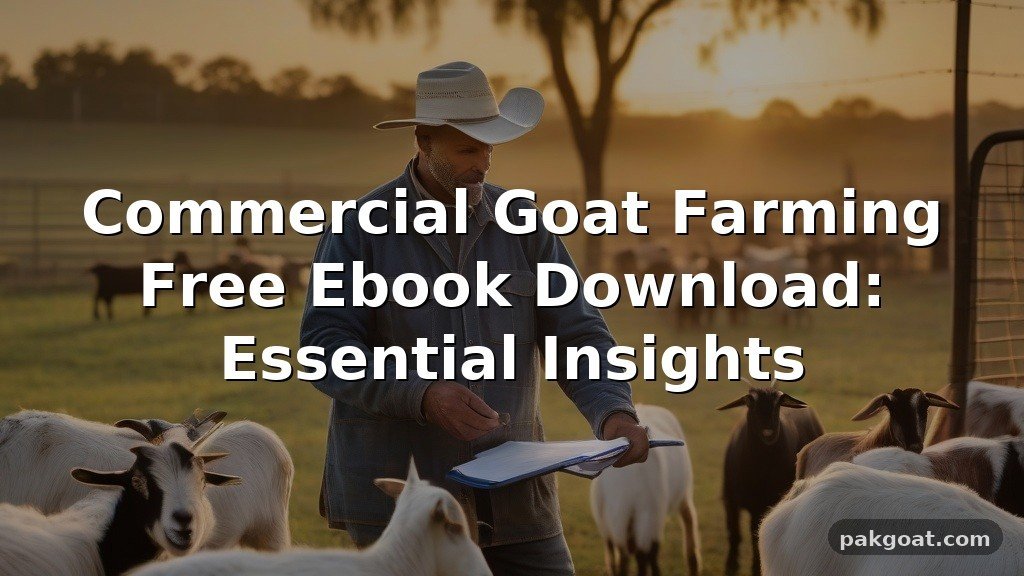
Finding a reliable commercial goat farming free ebook download is the first step for many aspiring producers looking to enter the livestock industry. These digital resources often provide the foundational knowledge required for effective animal husbandry, from selecting the right goat breeds to managing health and nutrition.
While a free guide can offer a strong starting point, success in this sector depends on applying those concepts to your specific climate, local market demand, and available capital. By understanding the core principles of intensive farming systems, you can build a more resilient operation that balances initial investment with long-term profitability.
Profitability and Herd Size Requirements
Many beginners ask how many animals are necessary to turn a profit, but the answer depends entirely on your production model. Most commercial operations aim for a herd size of at least 50 to 100 breeding does to achieve economies of scale. Smaller herds often struggle to cover the overhead costs of veterinary care, specialized fencing, and supplemental feed.
Key Factors Influencing Profit Margins
- Feed conversion ratio: High-performing breeds turn forage into weight gain more efficiently.
- Kidding interval: A target of 1.5 to 2 kidding cycles per year significantly boosts output.
- Market access: Proximity to urban centers reduces transport costs and increases fresh product pricing.
- Infrastructure efficiency: Automated waterers and modular housing reduce daily labor hours.
Comparing Goat Production Models
Choosing between meat production and dairy goats dictates your entire business plan and infrastructure needs. Meat-focused operations often rely on hardy, fast-growing breeds, while dairy ventures require significant investment in milking parlors and cold storage.
| Feature | Meat Production | Dairy Production |
|---|---|---|
| Capital Intensity | Moderate | High |
| Labor Frequency | Low to Medium | High (Daily Milking) |
| Product Shelf-life | Frozen/Fresh | Short (Perishable) |
| Primary Revenue | Carcass Weight | Milk/Cheese Volume |
Managing Land and Nutrition
Effective forage management is the backbone of any sustainable goat farm. Rotational grazing allows you to maximize the nutritional value of your forage crops while naturally breaking the life cycles of internal parasites.
If you are operating in a confined or semi-intensive setting, your feed conversion ratio becomes the most important metric for controlling costs. You must ensure that the nutritional value of your hay and grain supplements matches the growth stage of your livestock to prevent stunted development.
Essential Health and Biosecurity
Strict biosecurity protocols are non-negotiable when housing large numbers of animals in close quarters. Implementing a rigorous parasite control program, including regular fecal testing, prevents widespread illness that can devastate an entire herd.
You should keep a detailed health log for every animal, recording vaccinations, deworming dates, and any signs of respiratory distress. A well-maintained facility with good ventilation is often the best defense against common goat health issues.
Frequently Asked Questions
What is the most profitable goat product?
Profitability varies by region, but high-quality goat cheese and premium chevon (goat meat) typically command the highest margins. Niche markets, such as breeding stock sales or organic-certified products, can also yield higher returns than commodity-level sales.
How much land is needed for 1000 goats?
For intensive grazing, you might need 10 to 20 acres if you are heavily supplementing with external feed. If you rely primarily on pasture, you would need significantly more land—often 100 to 200 acres—depending on the carrying capacity of your soil and climate.
What are F1, F2, and F3 generations?
These terms refer to crossbreeding programs where F1 is the first generation of a cross between two purebred parents. F2 and F3 represent subsequent generations where the offspring are bred back to a parent breed or to each other to fix desired traits.
Is a business plan necessary for a small farm?
Yes, a written plan is essential for tracking your cash flow and forecasting potential losses. Even if you aren’t seeking bank financing, the process of writing it forces you to calculate your true costs of production.
Moving Forward with Your Farm
Starting your journey into this industry requires a commitment to continuous learning and rigorous data collection. While searching for a quality commercial goat farming free ebook download provides the theoretical framework, you must eventually adapt these lessons to the specific realities of your land and local market. Focus on mastering the basics of animal health and nutrition before scaling your herd size.
By keeping your operational costs low and your production standards high, you can build a sustainable and profitable agricultural business. Reach out to local agricultural extension offices or established producers in your area to complement your reading with practical, hands-on experience.
