

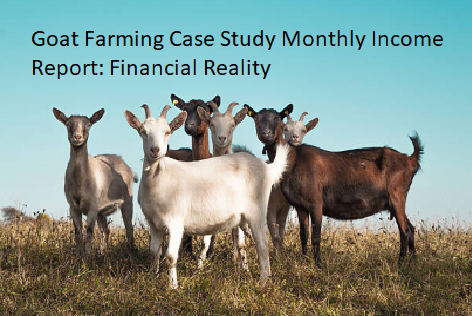
Analyzing a goat farming case study monthly income report reveals that profitability depends heavily on the scale of your operation and your chosen market niche. For a small-to-medium enterprise running roughly 50 breeding does, a well-managed farm can generate a net profit ranging from $800 to $1,500 per month after accounting for feed, veterinary care, and labor.
Success is not guaranteed, but consistent monitoring of your cost-per-animal and market weight targets makes these margins achievable. By reviewing actual data from successful operations, you can identify the specific expenses that eat into your bottom line and the revenue streams that actually drive growth.
Understanding Core Revenue Streams
Revenue in goat farming is rarely limited to a single output, and a detailed goat farming case study monthly income report will almost always show diversification. The primary income source for most farmers is the sale of meat goats, typically sold at weaning or after a finishing period. These animals are often marketed to local ethnic markets or through regional livestock auctions, where prices fluctuate based on seasonal demand.
Secondary income often comes from the sale of breeding stock, which commands higher premiums than meat animals. Farmers who invest in registered, purebred genetics can sell bucks or doelings to other producers looking to improve their herd quality. This segment of the business acts as a force multiplier for your average monthly income because the margins are significantly higher than commodity meat sales.
Milk production represents another potential revenue stream, though it requires a more rigorous daily commitment and specialized infrastructure. Operations focusing on dairy must account for the costs of pasteurization, packaging, and cold storage if selling directly to consumers. If you are selling raw milk to a creamery, your volume requirements will be much higher to justify the logistical expenses involved in transport.
Breakdown of Monthly Operating Expenses
The most significant drain on a monthly budget is almost always supplemental feed, especially during winter months or periods of drought. A standard goat farming case study monthly income report will show that forage quality dictates how much grain or hay you must purchase to maintain healthy body condition scores. Farmers who rely solely on pasture often see higher profit margins but may face slower growth rates in their kids.
Veterinary costs are often underestimated by beginners, leading to severe cash flow issues when an emergency arises. You must budget for routine deworming, vaccinations, and mineral supplements, which are non-negotiable for herd health. When you fail to maintain a strict health protocol, the resulting mortality rate or reduced weight gain will destroy your monthly profit projections faster than any other variable.
Labor costs are the final major component of your monthly outflow, whether you pay yourself or hire help. Even if you are a sole proprietor, you should assign a dollar value to your hours to determine if the enterprise is actually viable. If the operation cannot cover the cost of your time, it is effectively a hobby rather than a business, and your financial reporting should reflect that reality.
Comparative Income Performance Data
To understand the financial health of a goat farm, it is helpful to compare the performance of different operational models. The table below represents a hypothetical but realistic monthly performance snapshot for a mid-sized herd of 50 does. These figures assume a balanced approach to market sales and internal herd development.
| Revenue/Expense Category | Monthly Average ($) | Percentage of Total |
|---|---|---|
| Meat Goat Sales | $1,200 | 60% |
| Breeding Stock Sales | $500 | 25% |
| Feed and Mineral Costs | -$400 | 20% |
| Veterinary and Supplies | -$150 | 7.5% |
| Utilities and Miscellaneous | -$100 | 5% |
| Net Monthly Profit | $1,050 | 52.5% |
Scaling Operations for Increased Profitability
Moving from a small herd to a larger commercial operation changes the dynamics of your income report significantly. As your numbers increase, you gain economies of scale, allowing you to buy feed in bulk and reduce your per-head cost of production. However, this also introduces the need for higher-tier infrastructure, such as automated watering systems and improved fencing to manage larger grazing rotations.
Efficiency is the key to scaling without sacrificing the quality of your output. Implementing rotational grazing, as detailed by resources like the USDA Natural Resources Conservation Service, can significantly reduce your reliance on expensive supplemental feed. When goats move to fresh grass daily, their parasite exposure drops, which in turn reduces your monthly veterinary expenditures.
You must also consider the market ceiling when scaling up your herd size. Producing 500 goats is useless if you only have a local market capable of absorbing 100. Always ensure your marketing strategy evolves alongside your production capacity to avoid a backlog of inventory that ties up your working capital.
Common Financial Pitfalls to Avoid
Many new farmers fail because they purchase high-end equipment or expensive breeds before establishing a reliable income stream. A common mistake is investing in elaborate barns or state-of-the-art milking parlors that the current herd size cannot justify. Your capital expenditure should always be proportionate to the projected return on investment, not the aesthetic goals you have for the farm.
Over-stocking your land is another critical error that leads to hidden costs. When you push your acreage beyond its carrying capacity, you end up paying for hay and grain that the land should have provided for free. This creates a cycle of dependency on off-farm inputs that will permanently depress your monthly income figures.
Ignoring the seasonality of goat prices is a rookie mistake that can lead to selling at the absolute bottom of the market. Experienced farmers track the holiday calendars of various ethnic groups who consume goat meat, timing their breeding cycles to ensure kids reach market weight exactly when prices peak. Failing to align your production cycle with these demand spikes results in significantly lower annual revenue.
Strategic Planning for Long-term Growth
Sustainable growth in the goat industry requires a disciplined approach to record-keeping and financial analysis. You should be tracking the performance of every individual doe, identifying which animals are high producers and which are merely consuming resources. By culling the bottom 10% of your herd each year, you effectively raise the average profitability of your entire operation.
Diversification of income beyond the sale of live animals can also provide a buffer during lean times. Some farmers sell composted manure to local gardeners or offer educational workshops, which can add a steady stream of secondary revenue. While these activities take time, they often have very low overhead costs and can turn a break-even month into a profitable one.
Technology integration, such as using livestock management software, can provide the data needed to make informed decisions. Knowing exactly how much weight a specific kid gains on a specific diet allows you to optimize your feed program with extreme precision. These marginal gains, when aggregated across a full herd, result in a substantial difference in your monthly income report.
Key Performance Metrics for Success
To keep your goat farming case study monthly income report looking healthy, you must focus on specific metrics that track efficiency. The kidding percentage is perhaps the most vital indicator of your reproductive success. A rate below 150% usually signals that you need to re-evaluate your nutritional program or the fertility of your bucks.
Average Daily Gain (ADG) is the metric that tells you how well your meat goats are performing during the finishing phase. If your ADG is consistently low, you are likely losing money because the animals are staying on your farm longer than they should. Time is your most valuable asset, and keeping an animal for an extra month of feed to reach target weight is often a losing proposition.
Mortality rate must be kept under 5% to maintain a viable business model. High mortality indicates either inadequate husbandry, poor predator control, or an unsuitable environment. Each lost kid represents not just the loss of potential income, but also the sunk cost of the feed and time invested in that animal up to the point of its death.
Frequently Asked Questions
How many goats do I need to make a full-time living?
Most commercial goat farmers find that they need a minimum of 200 to 300 breeding does to generate a full-time income. This assumes you are vertically integrated or selling high-value products like breeding stock or premium dairy.
What is the biggest expense in a monthly goat farming budget?
Supplemental feed is almost always the largest monthly expense for most producers. This includes hay, grain, and specialized mineral licks required to keep the herd in top condition throughout the year.
Can I make a profit with just 10 goats?
You can certainly make a small profit, but it will likely function as a secondary income or a hobby. With 10 goats, you are best served by focusing on high-value niche markets or breeding stock rather than commodity meat sales.
How often should I update my income report?
You should update your financial records on a monthly basis to catch trends early. Waiting until the end of the year to review your numbers makes it impossible to adjust your management practices in response to rising costs or market shifts.
Is it better to focus on meat or dairy goats?
The choice depends on your local market and your available labor. Meat goats are generally less labor-intensive, while dairy goats provide a consistent, higher-frequency income stream but require significantly more daily management and infrastructure.
Closing Perspectives on Financial Sustainability
Achieving a consistent, positive result in a goat farming case study monthly income report requires more than just animal husbandry skills; it demands a rigorous commitment to business management. You must view your farm as a commercial entity where every dollar spent is scrutinized for its potential return. By focusing on efficient feeding, selective breeding, and timing your market sales to match peak demand, you can build a resilient and profitable operation.
Consistency is the ultimate goal in this industry. Do not be discouraged by the fluctuations that naturally occur over the course of a year, as seasonal cycles are a normal part of agricultural life.
Instead, use your monthly data to identify patterns and refine your strategy. If you stay disciplined with your records and remain adaptable to the needs of your local market, you will find that goat farming can indeed provide a reliable and satisfying source of income.
