

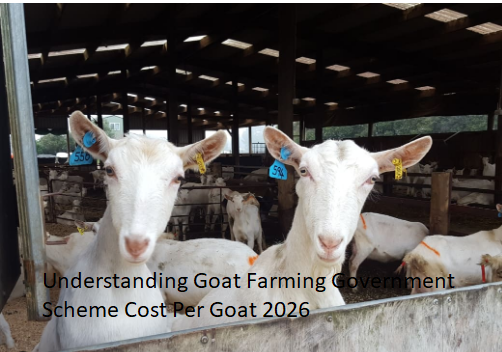
Understanding the financial structure of a goat farming government scheme cost per goat 2026 is the first step toward building a sustainable agricultural enterprise. Many aspiring farmers look for state-sponsored assistance to offset initial capital requirements, but navigating these subsidy structures requires clear data.
By analyzing the current fiscal landscape, you can determine how much of your investment is covered by grants and how much remains your responsibility. This analysis provides the specific figures and planning frameworks necessary to assess your project’s viability in the coming year, ensuring your business model aligns with available resources and governmental support policies.
The core of a goat farming government scheme cost per goat 2026 typically centers on a unit cost calculation rather than a flat grant. In many regions, the government sets a benchmark price per animal, often ranging between $150 and $250 per head, depending on the breed and local market conditions.
You are generally expected to cover a portion of this, while the subsidy covers the remainder, which frequently hovers around 30% to 50% of the total project cost. For a typical small-scale unit of 20 goats, the total project cost is often estimated at $4,000 to $6,000, with the government reimbursement arriving only after you have verified your infrastructure and livestock purchase.
Direct Costs and Subsidy Ratios
When you evaluate the financial requirements, you must distinguish between capital expenditure and operational costs. Capital expenditure includes the shed construction, fencing, equipment, and the initial purchase of the breeding stock.
A government scheme for 2026 will rarely cover recurring expenses like feed, medicine, or labor, focusing instead on the tangible assets. If your target is to establish a high-quality herd, you should budget for the full cost upfront, as subsidies are usually structured as reimbursement or back-ended incentives.
Managing the cash flow during the first six months is the most common hurdle for new farmers. You need to hold liquid capital equivalent to at least 60% of the total project value before the government subsidy is triggered.
This ensures that you can handle unexpected veterinary bills or fluctuations in feed prices without stalling the project. Keep all invoices from licensed breeders, as these are mandatory for claiming any state-backed financial aid.
Infrastructure Requirements for Eligibility
To qualify for any goat farming government scheme cost per goat 2026, your infrastructure must meet specific standards set by agricultural departments. Authorities often require a documented shed design that provides at least 12 to 15 square feet per animal.
Overcrowding is a frequent reason for the rejection of applications, as it leads to disease outbreaks and lower productivity. Your facility should include separate areas for nursing does, kids, and bucks to manage breeding cycles effectively.
Ventilation and sanitation are non-negotiable elements in the eyes of grant inspectors. You must demonstrate that the floor is elevated or easy to clean, and that there is a dedicated space for quarantine.
If you cannot prove that your facility prevents the spread of common caprine diseases, your application for subsidies will likely be denied regardless of your budget. Always check the official Food and Agriculture Organization guidelines for animal welfare, as many local schemes adopt these international standards to set their own compliance benchmarks.
Market Valuation and Breed Selection
The specific breed you choose significantly impacts the valuation metrics used in government schemes. Dairy-focused breeds, such as Alpine or Saanen, often attract higher government valuation caps than meat-focused breeds like Boer or Kiko.
When calculating your costs, ensure your business plan reflects the market rate for the specific genetics you intend to purchase. If the government valuation for a breed is $200 but you purchase a prize-winning animal for $500, the subsidy remains tied to the lower, standard valuation.
Comparing Costs Across Herd Sizes
Scaling your operation changes the cost-per-goat dynamic due to bulk efficiencies. A larger herd benefits from reduced per-animal costs for fencing and specialized equipment like automated feeders. The following table illustrates how the initial investment typically shifts as you scale up from a hobbyist level to a commercial enterprise.
| Herd Size (Number of Goats) | Estimated Total Setup Cost | Average Subsidy Percentage | Out-of-Pocket Requirement |
|---|---|---|---|
| 10 Goats | $2,500 | 35% | $1,625 |
| 50 Goats | $11,000 | 40% | $6,600 |
| 100 Goats | $20,000 | 45% | $11,000 |
Land and Forage Management
Land acquisition or leasing is a major factor that is often excluded from the goat farming government scheme cost per goat 2026. While the government may subsidize the animals and the shed, they rarely provide funds for purchasing land.
You must demonstrate that you have access to sufficient acreage for grazing or the ability to produce fodder. A general rule of thumb is that one acre of well-managed pasture can support approximately 6 to 8 goats depending on the quality of the forage.
If you rely solely on bought-in feed, your profit margins will shrink significantly, making your business model appear high-risk to loan officers and grant committees. Integrate a crop-rotation plan into your application to show long-term sustainability.
Providing proof of water availability, such as a borehole or dedicated irrigation, is another way to strengthen your application for financial support. Investors and government bodies look for proof that you have secured the land long-term, usually through a lease agreement of at least five years.
Administrative Hurdles and Documentation
The paperwork associated with securing funding is often more challenging than the farming itself. You need a detailed project report that includes a five-year financial projection, proof of address, and a technical training certificate.
Many regional authorities now mandate that applicants complete a short course on goat management before they are eligible to apply. This ensures that the capital provided by taxpayers is not wasted on inexperienced operators who might fail within the first year.
Organizing your records into a professional portfolio helps streamline the approval process. Keep a digital and physical copy of all receipts, veterinary health certificates, and land documentation.
If you are applying as part of a cooperative or a group, the documentation requirements may vary, but the emphasis on financial transparency remains the same. Do not underestimate the time required to process these applications, as local government offices often have specific windows for submission during the fiscal year.
Common Pitfalls in Cost Calculation
Many farmers fail because they underestimate the hidden costs of mortality and health management. You should account for a 5% to 10% mortality rate in your initial business plan, even if you are an experienced farmer.
Failing to include these figures makes your financial projections look unrealistic to government auditors. Additionally, remember to factor in the cost of insurance for your herd, as this is often a prerequisite for receiving state-backed loans or ongoing subsidies.
Another common mistake is ignoring the cost of waste management and environmental compliance. Local regulations may require you to install a bio-digester or a specific manure management system to qualify for certain grants.
If you fail to include these in your initial budget, you will face significant out-of-pocket expenses later. Always read the fine print of the scheme guidelines, as these often contain specific mandates for environmentally friendly farming practices that, while costly, are essential for eligibility.
Essential Steps for Success
* Verify your eligibility according to the current year’s residency and income criteria.
* Consult with a local veterinarian to ensure your shed design meets health standards.
* Prepare a formal project report that details your sourcing, marketing, and expansion strategy.
* Complete any mandatory government-sponsored training sessions for livestock management.
* Open a dedicated business bank account to keep your farming finances separate from personal expenses.
* Submit your application during the official window and follow up with the relevant department.
FAQ
Is the subsidy paid in advance or as a reimbursement?
Most government schemes function as a reimbursement. You must purchase the assets and complete the construction using your own capital or a bank loan. Once you submit the proof of purchase and an inspection is conducted, the government releases the subsidy amount into your account.
Does the government provide insurance for the goats?
Some specific agricultural schemes include a subsidized insurance component to protect against the loss of livestock due to disease or natural disasters. However, this is not universal. You should check if your specific regional scheme bundles insurance, or if you need to secure a private policy separately.
How many goats do I need to start to qualify for a scheme?
Eligibility requirements vary significantly by region. Generally, there is a minimum threshold to qualify as a commercial unit, often starting at 10 or 20 goats. Very small hobby farms with fewer than five animals rarely qualify for major government capital subsidies.
Can I apply for a subsidy if I am leasing the land?
Yes, most schemes allow you to apply if you are leasing land, provided you have a long-term lease agreement. The lease must usually be registered and cover a period of at least five years to ensure the stability of your farming operation.
What happens if I expand my herd after the initial grant?
Once the initial project is completed and the subsidy is paid, any further expansion is typically considered your own business activity. You may be eligible for separate grants for expansion or value-added processing, but these are distinct from the initial setup subsidy.
Conclusion
Securing support through a goat farming government scheme cost per goat 2026 requires careful preparation and a disciplined approach to financial planning. By understanding the specific unit costs, infrastructure requirements, and documentation standards, you position yourself to maximize the available assistance. Focus on creating a robust business plan that emphasizes long-term sustainability rather than just short-term gains, as this is what government auditors look for when approving funding.
Taking the time to research your local requirements and meeting all compliance standards will significantly increase your chances of success. As you prepare to enter the industry, ensure that your financial projections remain flexible enough to handle the realities of livestock management. Reach out to your local agricultural extension office to begin the application process and take the first step toward building your farm.
