

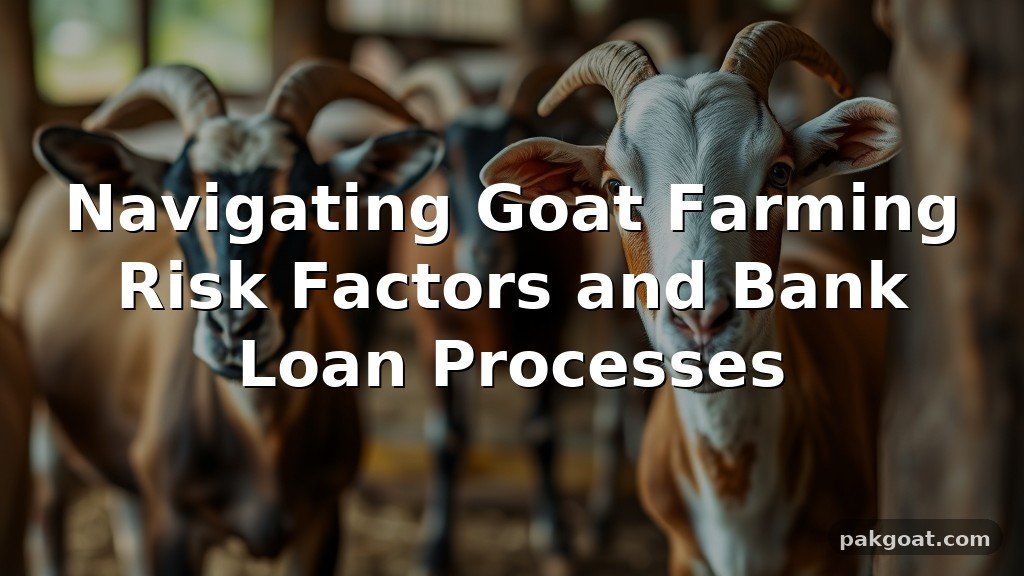
Understanding the goat farming risk factors bank loan process is essential for any aspiring producer looking to secure capital. Banks treat livestock ventures as high-risk agricultural loans, which means your preparation must be precise to meet strict underwriting criteria. You will gain clarity on how lenders evaluate your business plan, the specific financial ratios they monitor, and the operational risks that often trigger a loan rejection.
Securing institutional financing for a goat enterprise requires demonstrating that you can mitigate biological, market, and financial volatility. By aligning your business model with standard banking requirements, you increase your chances of approval while setting a foundation for long-term operational sustainability.
Core Risk Factors in Goat Farming
Lenders view livestock agriculture through a lens of biological uncertainty. Unlike a retail business with static inventory, goats are living assets susceptible to disease, reproductive failure, and environmental stress. A bank will immediately assess your mortality rate projections during the loan application process.
High mortality rates are the most common reason for default in the early years of a farm. If you cannot demonstrate a robust vaccination schedule and a clear veterinary intervention plan, the bank will classify your project as unbankable. They want to see that you have accounted for seasonal threats like pneumonia or parasite loads.
Market price volatility for goat meat and milk represents another significant risk factor. Prices fluctuate based on regional demand, ethnic holiday cycles, and feed costs. Your business plan must show how you will maintain positive cash flow when market prices drop below your cost of production.
The Bank Loan Evaluation Criteria
The goat farming risk factors bank loan process begins with a formal assessment of your creditworthiness and your collateral. Most commercial banks require a minimum down payment of 20% to 30% of the total project cost. They rarely finance 100% of a livestock operation because the asset itself is mobile and perishable.
Your Debt Service Coverage Ratio (DSCR) is the most critical metric in your application. Lenders generally expect a DSCR of at least 1.25, meaning your net operating income must be 1.25 times higher than your annual debt obligation. If your projected income barely covers the loan payment, the bank will view the loan as too risky.
Documentation is the backbone of your application. You must present a detailed three-to-five-year financial projection that includes profit and loss statements, balance sheets, and cash flow forecasts. Vague estimates are rejected immediately; you must provide data-backed figures for feed, labor, marketing, and emergency veterinary funds.
Essential Documentation for Loan Approval
A professional business plan for a goat farm must be more than a vision statement. It serves as your primary evidence that you understand the industry’s economic realities. Your plan should explicitly address how you intend to manage the specific goat farming risk factors identified by the bank.
Include a detailed list of your proposed assets and infrastructure. Lenders need to see that you have invested in appropriate housing, fencing, and waste management systems. If your facility design does not meet local health and environmental regulations, the bank will halt the process to avoid legal liability.
The following table summarizes the key financial metrics banks typically require to approve a livestock loan for a small-scale operation.
| Metric | Standard Expectation | Purpose |
|---|---|---|
| Debt Service Coverage Ratio | 1.25 or higher | Ensures ability to repay debt |
| Equity Contribution | 20% – 30% | Reduces lender exposure |
| Loan Term | 5 to 10 years | Aligns with asset lifespan |
| Liquidity Ratio | 1.5:1 | Shows short-term cash availability |
Managing Biological Risks for Lenders
Banks are inherently cautious about “biological lag,” which refers to the time between investing capital and generating revenue. In goat farming, this lag includes gestation periods, kidding intervals, and the time required for kids to reach market weight. You must explain how you will survive this period without external income.
Infrastructure security is a major focus for rural lenders. They will look for protection against predators, extreme weather, and theft. If your farm lacks secure perimeter fencing or a proper quarantine area, the bank will deem your operational plan incomplete.
For those interested in the broader scope of agricultural lending, the Farm Service Agency provides detailed guidance on federal loan programs that may be more accessible than traditional commercial bank loans. These programs often have specific provisions for beginning farmers who might not meet the strict collateral requirements of private institutions.
The Role of Market Strategy in Loan Approval
A common mistake in the goat farming risk factors bank loan process is failing to identify a specific market. Lenders want to know exactly who is buying your product and at what price point. You must provide contracts or letters of intent from processors, local butcher shops, or restaurant distributors.
If you plan to sell through live auctions, explain how you will handle price instability. A bank will be more comfortable with your application if you have diversified your income streams. For instance, selling milk, meat, and manure can provide a buffer against the failure of one specific product line.
* Diversified Income Sources:
* Sale of live kids for meat production.
* Processing and sale of goat milk or artisanal cheeses.
* Sale of breeding stock to other producers.
* Composted manure sales to local organic farms.
* Agritourism or educational farm tours.
Analyzing Operational and Management Risks
Lenders evaluate the “Three Cs” of credit: Character, Capacity, and Capital. In the context of goat farming, “Character” translates to your management experience. If you have no prior experience with livestock, the bank will likely require you to partner with a mentor or hire a manager with a proven track record.
Your operational plan must account for daily labor requirements. Goat farming is labor-intensive, particularly during the kidding season. If your plan does not account for the high cost of skilled labor or the physical toll on the farmer, the bank will flag the operation as unsustainable.
Furthermore, consider your feed procurement strategy. Feed costs are the largest variable expense in goat farming.
If you are reliant on purchased hay or grain, you are vulnerable to commodity price shocks. A detailed plan for pasture management or on-farm feed production demonstrates that you are proactively managing this risk.
Addressing Environmental and Regulatory Compliance
Environmental risk is a silent killer of loan applications. Goat farms produce significant waste, and runoff can contaminate local water sources. If your farm is located near a protected watershed, you will face intense scrutiny regarding your waste management plan.
You must be prepared to provide permits from local environmental agencies. If these permits are pending, clearly state the expected timeline for approval. A bank will not approve a loan if there is a high probability of a future shutdown due to environmental non-compliance.
Additionally, animal welfare regulations are becoming stricter globally. Your farm must adhere to humane handling standards to avoid reputational and legal risks. Lenders often check for compliance with state-level agricultural codes to ensure the business is not at risk of fines or forced closure.
The Final Loan Approval Timeline
The timeline for the goat farming risk factors bank loan process is rarely short. After submitting your initial application, expect a period of due diligence that can last from 60 to 120 days. During this time, the bank will conduct site visits and audit your financial history.
Be prepared for a “Request for Information” stage where the bank asks for clarification on your expense projections. Do not treat these questions as a sign of rejection; they are a standard part of the underwriting process. Providing prompt, accurate, and professional responses during this phase is vital to maintaining the momentum of your application.
Once the bank finishes the audit, they will issue a commitment letter if they approve the loan. This document outlines the interest rate, repayment schedule, and any covenants you must follow. Read these terms carefully, as they often include requirements for ongoing financial reporting and insurance coverage.
Conclusion
Securing a loan for a goat farm is a test of your planning and financial transparency. By addressing the goat farming risk factors bank loan process with a realistic, data-driven approach, you demonstrate to lenders that you are a serious operator capable of managing a complex biological business. Focus on maintaining a strong debt service coverage ratio and clearly documenting your operational safeguards to build the credibility needed for approval.
The path to funding requires patience and a willingness to adapt your business plan to meet institutional standards. Keep your financial records organized and stay informed about industry trends to ensure your farm remains competitive. If you approach your application as a professional enterprise rather than a lifestyle project, you significantly increase your chances of obtaining the necessary capital to grow your agricultural venture.
