

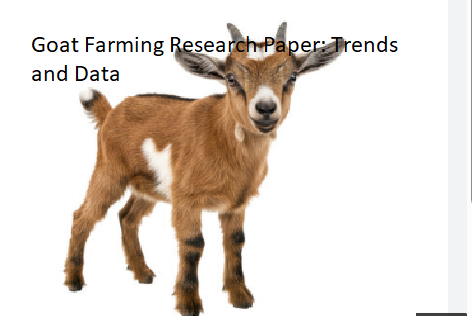
A well-structured goat farming research paper provides the empirical foundation necessary for modern livestock management. By examining physiological data, nutritional requirements, and market trends, producers can transition from traditional subsistence methods to data-driven commercial operations. This article synthesizes critical information found in a typical high-quality goat farming research paper to help you understand the technical side of the industry.
Scientific inquiry into caprine management focuses heavily on optimizing feed conversion ratios and disease resistance. When you review a credible goat farming research paper, you will find that the primary determinant of profitability is the Feed Conversion Ratio (FCR).
Studies consistently show that well-managed herds achieve an FCR of approximately 4:1 to 6:1, depending on the breed and the quality of forage provided. Achieving these figures requires precise monitoring of dry matter intake versus weight gain over a 12-month cycle.
Nutritional Requirements and Feed Efficiency
Modern research emphasizes that protein density in the diet dictates the growth rate of meat breeds like the Boer or Kiko. A standard goat farming research paper often notes that a crude protein level of 14% to 16% is ideal for lactating does. Below this threshold, milk yield drops significantly, which directly impacts kid survival rates during the first 60 days of life.
Energy density remains the second most critical variable in caprine nutrition. During the winter months, supplemental energy in the form of grains or high-quality silage is essential to maintain body condition scores.
Researchers have found that goats grazing on diverse vegetation demonstrate higher immune function than those kept on monoculture pastures. This biological diversity provides trace minerals that are often missing in standardized commercial pellets.
Genetic Selection for Herd Improvement
Genetic progress is the most effective way to increase long-term output without increasing the physical footprint of the farm. Most peer-reviewed studies focus on the heritability of traits such as litter size, weaning weight, and parasite resistance. You should prioritize breeding lines that exhibit strong FAMACHA scores, which indicate natural resistance to Haemonchus contortus, a common stomach worm.
Selecting for specific traits requires meticulous record-keeping. A professional goat farming research paper usually includes data tables showing the correlation between sire performance and offspring weight gain at 90 days.
Breeders who use estimated breeding values (EBVs) see a faster rate of improvement than those who rely solely on visual appraisal. This shift toward quantitative selection is a hallmark of successful commercial goat operations.
Disease Management and Biosecurity
Health protocols are a major component of any comprehensive goat farming research paper. Parasite management has moved away from blanket chemical deworming toward integrated pest management (IPM) strategies. This transition is necessary because many gastrointestinal parasites have developed resistance to common anthelmintics like ivermectin.
Biosecurity measures act as a firewall against costly outbreaks of diseases like Caseous Lymphadenitis (CL) or Caprine Arthritis Encephalitis (CAE). Researchers recommend a strict quarantine period of 30 days for any new animal introduced to the farm. Blood testing during this window prevents the silent spread of viral pathogens that can devastate an entire herd.
- Maintain a closed-herd policy to prevent the introduction of new pathogens.
- Implement a rotational grazing schedule to break the parasite life cycle on pastures.
- Use individual identification tags for all animals to track medical history and vaccination dates.
- Provide clean, elevated water sources to prevent contamination from fecal matter.
- Consult a licensed veterinarian to create a vaccination schedule specific to your local region.
Economic Analysis of Caprine Production
Understanding the financial structure of the industry is vital for anyone analyzing a goat farming research paper. Profit margins are thin, often ranging between 10% and 20% for well-run operations. The largest recurring expense is typically supplemental feed, which can account for up to 60% of total operating costs.
Labor costs represent the second largest expenditure, particularly during the kidding season. Automating water delivery and using efficient fencing designs can reduce the hours required for daily maintenance. The following table illustrates a typical breakdown of operational costs for a medium-sized commercial goat farm.
| Expense Category | Percentage of Total Budget |
|---|---|
| Supplemental Feed | 55% |
| Labor and Management | 20% |
| Veterinary and Medical | 10% |
| Infrastructure and Maintenance | 10% |
| Marketing and Miscellaneous | 5% |
Environmental Impact and Grazing Ecology
Goats are increasingly recognized for their role in sustainable land management and invasive species control. A recent goat farming research paper might highlight how targeted grazing can reduce the need for mechanical or chemical brush clearing. By browsing on woody plants, goats prevent the encroachment of shrubs into valuable grassland areas.
However, overgrazing remains a significant risk that can lead to soil erosion if stocking rates are not managed correctly. Researchers suggest a stocking density of 4 to 6 goats per acre, depending on the biomass productivity of the land. Properly managed, goats can actually improve soil fertility through the deposition of nutrient-rich manure across the pasture.
Reproductive Efficiency and Kidding Cycles
The reproductive cycle is the engine of any goat farm. To maximize output, many producers aim for a three-kidding-in-two-years cycle. This requires early weaning of kids at approximately 60 to 90 days to allow the doe sufficient time to recover body condition before the next breeding cycle.
Light manipulation is a common research topic for out-of-season breeding. By controlling the photoperiod in the barn, producers can induce estrus in does during the spring, ensuring a steady supply of meat or milk throughout the year. This technique has been shown to increase annual revenue by stabilizing market supply, which fetches higher prices during off-peak seasons.
Market Trends and Consumer Demand
The demand for goat products is shifting beyond niche ethnic markets into mainstream retail. A goat farming research paper tracking these trends often notes a significant increase in the consumption of goat meat, or chevon, in urban centers. This growth is driven by the perceived health benefits of goat meat, which is lower in cholesterol and fat compared to beef or lamb.
Producers who process their own milk into cheese or yogurt capture a much higher percentage of the value chain. Diversification into value-added products is a common recommendation in agricultural economics literature. You can find more detailed information on regional production standards through the United States Department of Agriculture research portal.
Technological Integration in Livestock Management
Precision livestock farming (PLF) is transforming how producers monitor herd health. Wearable sensors that track rumination time and activity levels can alert farmers to illness before visible symptoms appear. A goat farming research paper focusing on technology often highlights how these tools reduce mortality rates by as much as 15%.
Automated weighing systems at water troughs allow for real-time tracking of growth rates without the stress of frequent handling. These systems collect data continuously, providing a level of granularity that was previously impossible to achieve. As hardware costs decrease, these technologies are becoming accessible to smaller, family-run operations looking to optimize their efficiency.
Frequently Asked Questions
What is the most common cause of death in goat herds?
The most common cause of mortality in goats, particularly in young kids, is respiratory disease and parasitic infestation. Maintaining dry, well-ventilated housing and a consistent deworming protocol based on fecal egg counts is the best way to mitigate these risks.
How many goats are needed to make a profit?
Profitability depends heavily on your local market and your cost of production. Generally, a herd of 50 to 100 does is considered the minimum size required to justify the necessary capital investment in infrastructure and equipment.
Are goats difficult to keep healthy compared to cattle?
Goats are more susceptible to internal parasites and require more precise nutritional management than cattle. They are browsers rather than grazers, meaning they thrive on a more diverse diet, which requires more careful pasture management to prevent health issues.
What is the best breed for meat production?
The Boer goat is the industry standard for meat production due to its rapid growth rate and carcass yield. However, Kiko and Spanish goats are often preferred in regions with higher parasite pressure due to their superior natural hardiness and disease resistance.
How often should a goat farm be audited for health?
A formal health audit should be conducted at least twice a year, ideally before and after the kidding season. This involves reviewing vaccination records, parasite load data, and individual animal weight performance to ensure the herd remains on a positive trajectory.
Key Takeaways for Producers
Managing a successful operation requires a firm grasp of the principles found in a high-quality goat farming research paper. By focusing on feed efficiency, genetic selection, and proactive health monitoring, you can build a resilient and profitable business. The industry is moving toward data-driven decision-making, where every kilogram of feed and every hour of labor is tracked for maximum impact.
Start by implementing a simple record-keeping system that tracks your feed costs and growth rates. Use this data to make informed choices about your breeding stock and pasture management. As you refine your processes, you will find that the scientific approach to goat farming research paper concepts leads to more consistent results and higher overall returns on your investment.
