

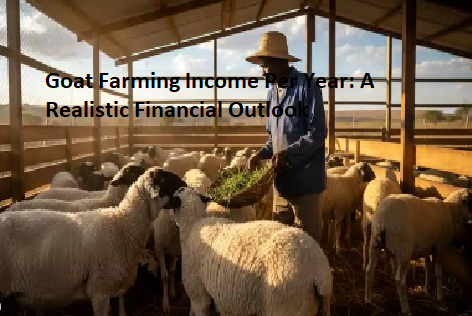
Calculating your potential goat farming income per year requires moving beyond simple assumptions and looking at the specific economics of meat, milk, and fiber production. While hobbyists might view the venture as a lifestyle choice, professional operations rely on rigorous cost-benefit analysis to remain sustainable.
This article examines the revenue streams, operational expenditures, and market variables that dictate your annual bottom line. By understanding the fiscal realities of livestock management, you can build a business model that survives market fluctuations.
Defining Annual Revenue Expectations
A small-scale commercial goat operation typically sees a net profit ranging from $50 to $150 per doe annually, depending heavily on whether you focus on meat or dairy. If you are running a herd of 50 breeding does, your gross revenue might hover between $8,000 and $15,000, assuming you manage your overhead costs strictly.
These figures are not guaranteed, as they fluctuate based on local demand for kid meat and the cost of quality forage. The most successful farmers treat the farm as a manufacturing plant where every animal’s output is measured against its intake cost.
Primary Revenue Streams
Goat farming income per year is rarely derived from a single source; diversification is the hallmark of a resilient farm. Most operators combine meat sales with the sale of breeding stock, manure, or high-quality milk products.
Meat goat production often focuses on the “ethnic market,” where demand peaks during specific religious holidays. Breeding stock sales offer higher margins, as a registered purebred buck can command $500 to $1,500 compared to a slaughter-weight kid worth $150 to $200.
- Meat sales: Selling kids at 4–6 months for ethnic markets or local butchers.
- Breeding stock: Selling registered or high-quality performance goats to other farmers.
- Dairy products: Processing raw milk into cheese, yogurt, or soap for retail.
- Manure sales: Selling composted goat waste to organic vegetable gardeners.
- Agritourism: Hosting farm tours or “goat yoga” sessions to diversify revenue.
Managing Operational Expenditures
The largest drain on your annual income is feed, which can account for 50% to 70% of your total operating costs. Pasture management is the most effective way to lower this number, as rotational grazing reduces the need for expensive stored hay and grain.
Veterinary expenses, including vaccinations, dewormers, and occasional emergency calls, typically consume another 10% to 15% of your budget. Fixed costs such as insurance, property taxes, and fence maintenance remain regardless of your herd size, making scale a critical factor for profitability.
Financial Comparison Table
Understanding the difference between revenue and profit is essential for long-term survival. The table below illustrates the typical financial breakdown for a small-scale, 50-doe meat goat operation. These figures represent average market conditions and assume efficient management practices.
| Expense or Revenue Category | Estimated Annual Amount |
|---|---|
| Gross Revenue (Sales of Kids/Stock) | $12,500 |
| Feed and Supplement Costs | $5,500 |
| Veterinary and Medical Supplies | $1,200 |
| Infrastructure Maintenance | $800 |
| Miscellaneous/Marketing Costs | $500 |
| Net Annual Profit | $4,500 |
The Impact of Herd Size on Profitability
Scaling up your operation fundamentally changes your goat farming income per year by allowing for better bulk purchasing of feed and veterinary supplies. A herd of 10 goats often requires a disproportionate amount of labor and equipment relative to the revenue produced.
Once you reach a threshold of 100 to 200 breeding does, you can justify investing in automated milking systems or specialized handling equipment. Efficiency gains at this scale can increase your profit per head by lowering the labor hours required per animal.
Market Variables and Timing
Timing your production cycle to hit peak market prices is a sophisticated strategy used by seasoned farmers. Prices for meat goats often spike significantly during holidays like Easter, Ramadan, and Eid al-Adha.
To capitalize on this, you must adjust your breeding schedule so that your kids reach market weight exactly when demand is at its highest. Failure to align your production schedule with these market windows can result in selling your stock when prices are at their lowest seasonal ebb.
Infrastructure and Capital Investment
Before you can generate a consistent goat farming income per year, you must commit to a significant initial capital investment. Building secure, predator-proof fencing is the most critical infrastructure expense, often costing between $3,000 and $7,000 per acre depending on the materials used.
You also need adequate housing to protect the herd from extreme weather and to provide a clean environment for kidding. These capital costs should be amortized over the life of the assets to accurately reflect your true annual business costs.
Risk Mitigation and Insurance
Livestock farming is inherently risky, with threats ranging from disease outbreaks to predator attacks and extreme weather events. Comprehensive farm insurance is a mandatory expense, as a single major health crisis can wipe out your entire profit margin for the year.
The United States Department of Agriculture provides various resources for livestock producers to understand federal risk management programs and disaster assistance. Protecting your capital assets—the breeding herd—should be prioritized over short-term revenue gains.
Sustainable Management Practices
Long-term profitability relies on maintaining the health of your land, which is your most valuable asset. Overgrazing leads to soil erosion and the encroachment of weeds, which eventually forces you to spend more on supplemental feed.
Practicing intensive rotational grazing ensures that your pastures remain productive, effectively turning sunlight and grass into cash. By managing the land properly, you reduce the need for fertilizers and chemical inputs, which directly improves your annual margins.
Frequently Asked Questions
Do goat farmers make good money?
Most goat farmers operate with slim margins, and “good money” is subjective. It is rarely a get-rich-quick scheme, but rather a business that rewards efficiency, scale, and careful market analysis.
How much land is required for 100 goats?
While you can keep 100 goats on as little as 5 to 10 acres with intensive management and supplemental feeding, a more sustainable approach for pasture-based systems is 20 to 50 acres. The exact amount depends on your local climate, soil quality, and the forage species available.
How many goats do I need to be profitable?
Profitability depends on your specific business model and overhead costs. Many experts suggest that a minimum of 30 to 50 breeding does is required to justify the time and infrastructure costs of a professional-grade operation.
What is the biggest expense in goat farming?
Feed is consistently the largest annual expense for goat farmers. Controlling this cost through rotational grazing and high-quality pasture management is the single most effective way to improve your yearly income.
Can I make a living exclusively from goats?
Making a full-time living from goats is possible, but it usually requires a large herd size, vertical integration, and a direct-to-consumer sales model. Most small-scale farmers treat the venture as a significant supplemental income stream rather than their only source of revenue.
Building a Sustainable Future
Achieving a stable goat farming income per year requires a disciplined approach to both animal husbandry and business management. You must track your expenses with the same rigor you apply to your herd’s health, ensuring that every dollar spent contributes to your long-term growth.
Diversification, careful timing of market sales, and a focus on low-cost, pasture-based feeding are the pillars of a successful operation. By treating your farm as a professional enterprise rather than a hobby, you can navigate the complexities of the agricultural market.
Start by auditing your current production costs and identifying areas where efficiency can be improved. Once your systems are optimized, you can explore scaling your herd or adding value-added products to increase your annual revenue.
Success in this field is built over seasons, not days, so stay focused on incremental improvements. If you are prepared to manage the risks and commit to the necessary labor, the potential for a consistent return on your investment remains a reality.
